Snakes first appeared during the age of dinosaurs, but fossils of many early species are so fragmentary that scientists have had difficulty deciphering their evolution as a group. Now, a well-preserved fossil from southeastern Brazil is offering fresh insight into the history of these slithering reptiles.
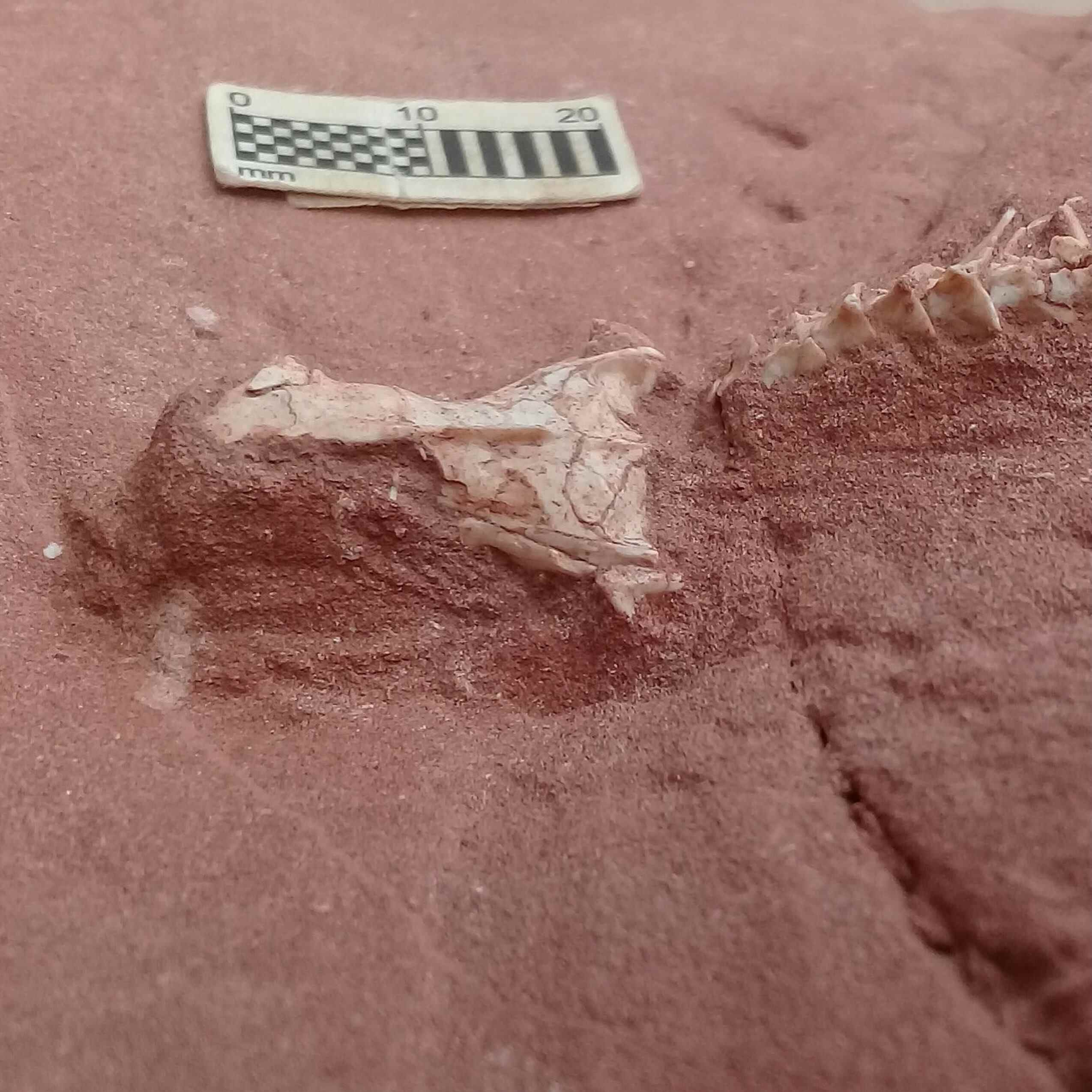
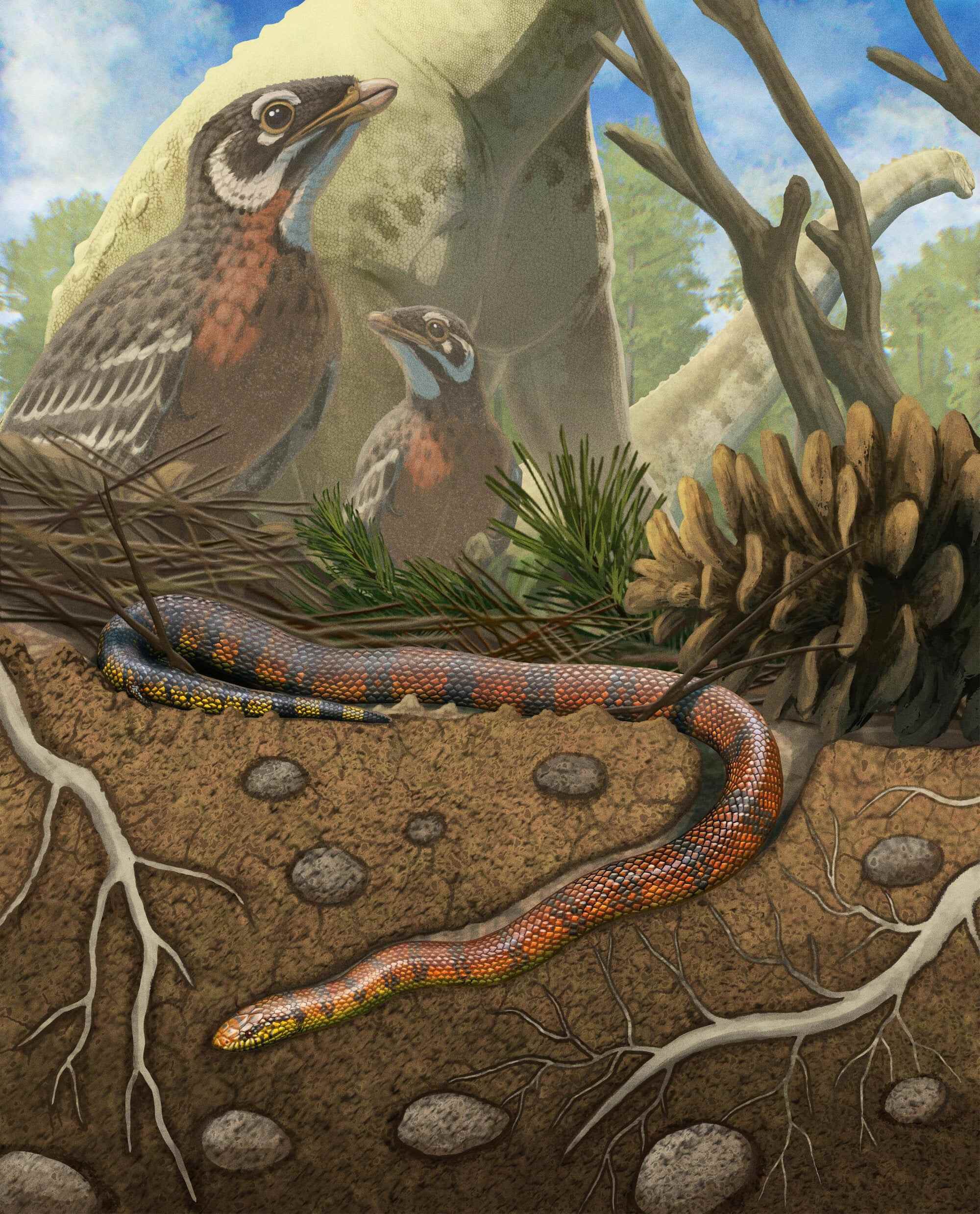
The fossil is of a snake called Tametara mirim that lived between 75 and 85 million years ago during the Cretaceous Period and measured about 42cm (17 inches) long. It inhabited a lush ecosystem alongside animals including enormous long-necked plant-eating dinosaurs, crocodiles and birds.
While the fossil does not retain all of Tametara’s anatomy, a portion of the skull is so well preserved that it has enabled researchers to reconstruct the snake’s brain anatomy. The brain shape and skull bone microstructure show that this species lived a fossorial (burrowing) lifestyle, as do many present-day species such as coral snakes.
Snakes evolved from lizard ancestors and are thought to have first appeared roughly 170 million years ago during the Jurassic Period.
But there are no well-preserved snake fossils from the Jurassic and only a handful from the subsequent Cretaceous, the final chapter in the age of dinosaurs.
“Snakes represent one of the most extreme body plans among all vertebrates: animals with a backbone,” says Tiago Simoes, an evolutionary biology professor at Princeton University in the US and lead author of a study about the new fossil published this week in the journal Nature.
“Understanding the origin of this peculiar and yet highly diverse group remains one of the biggest mysteries in vertebrate evolution.”
How the fossil reveals a more complex history of snake evolution
Simoes says that roughly 60 per cent of the skull and 70 per cent of the vertebral column are preserved in the fossil, which was found in the municipality of Presidente Prudente in the Brazilian state of Sao Paulo.
Most of the cranial region that was preserved was formed by the braincase and skull roof bones, with the back part of the lower jaw positioned as it would have been in life.
“Tametara enters a highly selective hall of spectacularly preserved Cretaceous snakes, with only four species in total with similar preservation. It tells us something we never thought we could learn from fossils until recently: the early evolution of their central nervous system,” Simoes says.
“This reveals a more complex history of early snake evolution: a larger early diversity of neurosensory adaptations in snake evolution and an evolutionary trajectory of adaptations towards different environments that was not quick nor linear. It involved multiple and independent incursions of snakes across different environments during their long evolutionary history.”
Fossils have shown that Cretaceous snakes adapted to burrowing, ground-dwelling and marine lifestyles.
“We predict the ancestral condition for all snakes was not one strongly adapted to a single habitat. Rather, it was a transitional one, lying in the interface of fossorial and ground-dwelling environments,” Simoes says.
He adds that Tametara most likely preyed on insects, but there is no direct evidence of diet. Because the fossil lacked teeth, it was unclear whether Tametara was venomous, as coral snakes are.
While all extant snakes are limbless, fossils show that early snakes retained back legs. The hip area of the Tametara fossil was not preserved, but Simoes says the snake almost certainly had robust hind limbs, like its sister Cretaceous species Najash rionegrina.
Tametara has no direct descendants alive today, Simoes says.
What the brain anatomy tells us
Based on cranial fossils, the researchers reconstructed the brain anatomy not only of Tametara but of a second Cretaceous snake, the ambush predator Dinilysia patagonica, which grew to between two and three metres long.
“Their brain shapes substantially departed from each other and from most modern lineages of lizards and snakes,” Simoes says. “This means they had substantial neuroanatomical diversity, and likely sensorial functions, early on in snake evolutionary history.”
Knowing the brain of any organism is fundamental to understanding its basic functioning and how it interacts with the world, Simoes explains.
“Tametara’s brain had comparatively smaller cerebral hemispheres, the brain’s cognitive part, and also a smaller optic tectum, one of the brain parts responsible for vision, than many modern snakes. Some of these differences reflect its burrowing behaviour, as burrowers have [fewer] requirements for visual acuity than animals living above ground.”