If you are interested in joining future Face Off debates, fill out this form to submit your application.
For: Valerie Chiu, 16, St Mary’s Canossian College

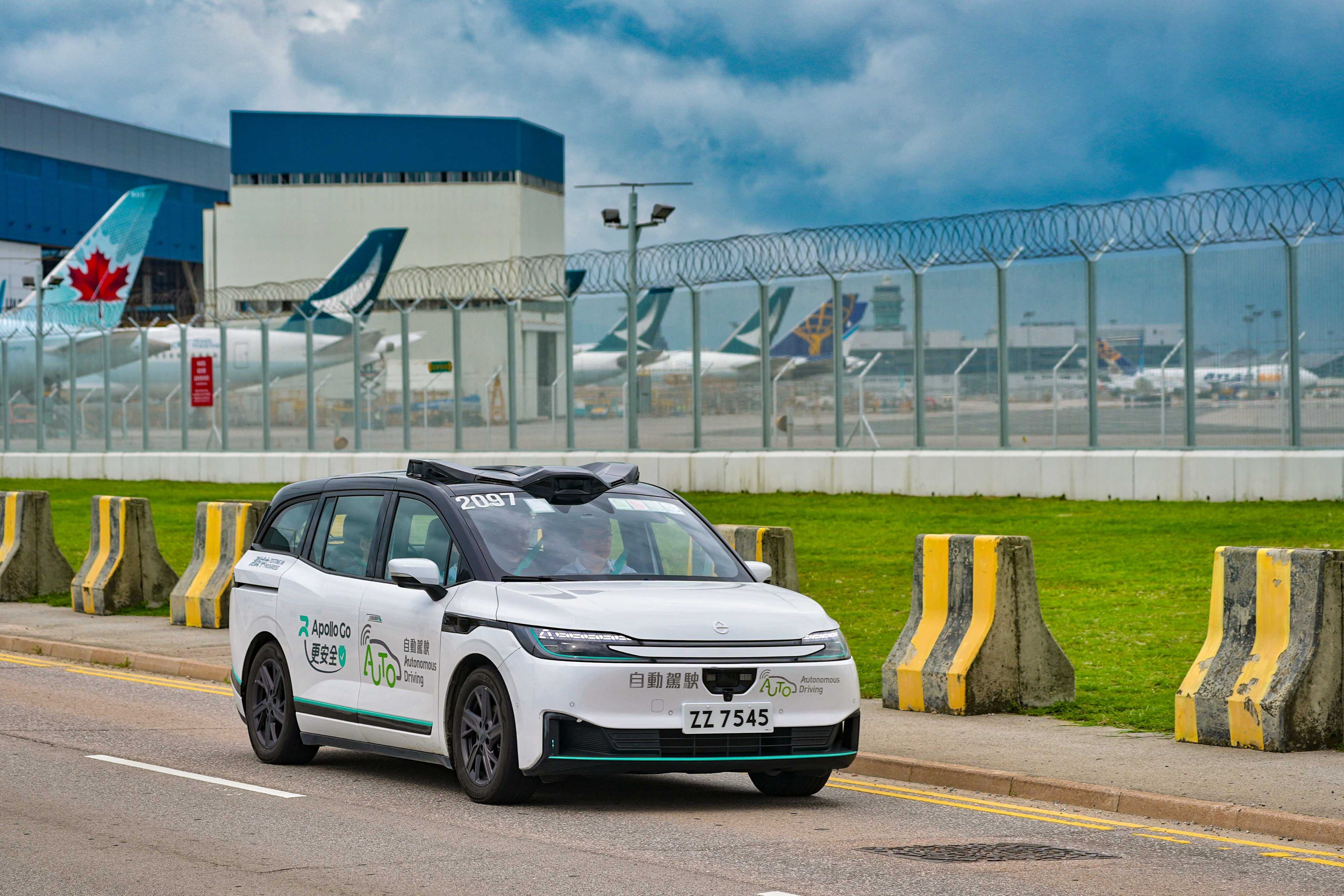
Imagine cars smoothly lining up and gliding along the road without drivers. This is no longer just a dream; driverless cars have already been tested at locations like Hong Kong’s airport and the West Kowloon Cultural District.
While some people are sceptical about the presence of autonomous vehicles on public roads, it is clear that they offer more benefits than drawbacks to society.
Allowing driverless cars on the road introduces a new commuting option that provides significant advantages in terms of safety, accessibility and efficiency.
Driverless cars have the potential to significantly reduce traffic accidents by eliminating human error. According to an analysis published in 2024 in the journal Nature Communications, human drivers generally are more prone to accidents than cars with advanced driving systems.
By reducing these traffic risks, autonomous vehicles can create safer road conditions for both passengers and pedestrians.
One of the key benefits of driverless cars is their potential for accessibility. They offer increased mobility for the elderly, disabled individuals and others who are unable to drive themselves. This technology enhances the confidence and autonomy of these groups, contributing to a more inclusive community.
Some people are concerned about job losses for drivers. However, driverless cars do not eliminate the need for human expertise.
The knowledge of drivers can be redirected to maintaining, repairing and enhancing autonomous systems, complementing the work of engineers and IT developers. This shift creates new opportunities.
Some people point out that autonomous vehicles may increase power consumption for navigation. While this may be true at present, allowing these vehicles on public roads will motivate scientists to develop more environmentally friendly models.
History has shown that widespread adoption often accelerates breakthroughs in energy efficiency, as seen with smartphones and electric vehicles. Driverless cars can follow a similar path.
Driverless cars should be permitted on public roads. By taking this important step, we can embrace technological advancements and work towards a more sustainable future.
Against: Peter Chui Pui-ling, 17, Maryknoll Fathers’ School

While driverless vehicles are often praised and celebrated, they also have significant flaws and dangers. Therefore, they should not be allowed to operate on public roads at this stage.
Autonomous driving technology presents unresolved safety concerns for all road users. Driverless vehicles rely on sensors to monitor real-time road conditions.
However, the camera sensors integrated within these self-driving systems are essentially algorithms and do not possess the capabilities to make decisions in response to real-world incidents.
The readings of automatic sensors can be affected by natural weather conditions and challenging visibility situations like dim street lighting at night, overwhelming glare from sunsets and scattered debris.
When a driverless vehicle’s programmes fail to assess the current environment or respond accurately, this can lead to dangerous misjudgments. Such errors can put pedestrians, bicyclists and citizens’ private property at risk during traffic collisions.
Unlike human drivers, who can make critical life-or-death decisions during sudden roadside emergencies, automated driving systems are limited to operating within the scope of their training.
This significant difference suggests that driverless cars should be banned on public roads.
Additionally, there is currently no fair legal framework to determine liability when a driverless car causes an accident, leaving victims caught in prolonged and unfair disputes. In accidents involving traditional human-driven vehicles, liability is clearly assigned to the driver’s negligence.
However, with autonomous vehicles on public roads, accountability becomes blurred. Who should be held responsible after a serious collision? Is it the vehicle manufacturers, whose defective sensor hardware may be the cause of the system’s misjudgment?
Currently, the absence of a legal standard for addressing fatal collisions involving autonomous vehicles leads to significant regulatory uncertainty.
Overall, driverless vehicles still face safety issues related to their technology, and the global legal system has yet to establish clear guidelines for resolving liability disputes in the event of accidents. Therefore, driverless vehicles should remain banned from public roads.