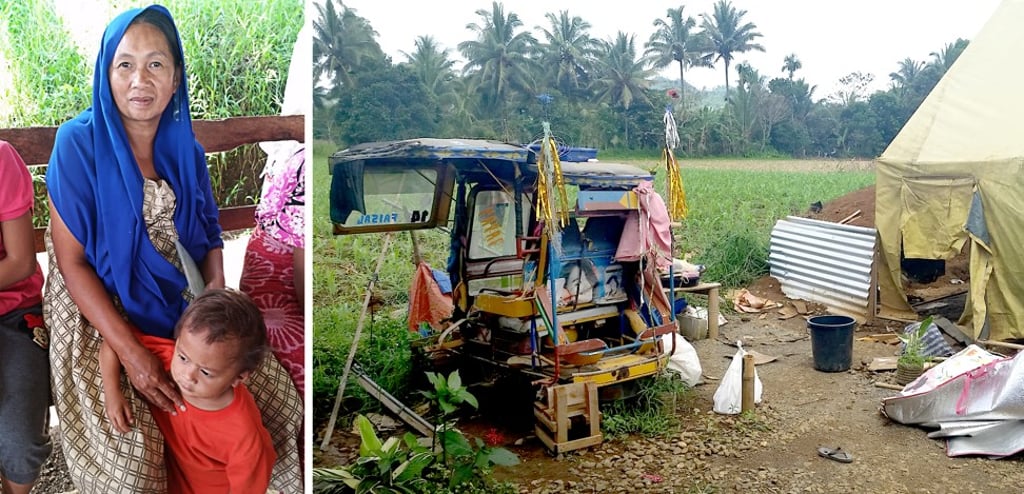
Faisal’s life has ground to a halt. Looking out forlornly to a lush paddy field, this “tricycle” – as the sidecar is called in the Philippine hinterland, where it’s the main mode of public transport – is waiting out its exile on the edge of a refugee camp. Now a heap of rusting metal and wood with a garnishing of creeping foliage, there’s no sign of the motorcycle that once drove it. Only the windscreen, washed by the frequent Mindanao showers, remains unconquered. Emblazoned with FAISAL in blue, it shimmers in the midday sun.
Ali Bashar Usman named his tricycle after his eldest son, who in turn is named after a late Saudi king. Usman fled Marawi with his wife and six children in it when war broke out in the Philippines’ only “Islamic city” in May last year between government forces and a group of youths who lay siege to the city and pledged their allegiance to Islamic State (IS). The government immediately declared martial law in the entire southern island of Mindanao of 22 million people, where Marawi is the capital of the Lanao del Sur province. The battle raged for five months. In October, President Rodrigo Duterte announced the main rebel leaders had been killed and Marawi “liberated”.
Faida Mamayandig and the Usmans’ tricycle. Photos: Debasish Roy Chowdhury
But that means little to the Usmans, trapped in an evacuation camp with little prospect of making it back to their home as they knew it, in a city laid to waste. A year after the conflict erupted, the family is among the 237,000 people – or 67 per cent of the city’s population of 353,000 – who remain displaced. Those who managed to salvage sufficient resources before fleeing found places to rent elsewhere. Others moved in with relatives or friends in nearby towns and villages. But for the likes of Usman, a tricycle driver with neither the resources nor resourceful acquaintances, a yellow tarpaulin tent it is, with no electricity and limited water, on the outskirts of the nearby city of Iligan.