
Deep Dive delves into hot issues in Hong Kong and mainland China. Our easy-to-read articles provide context to grasp what’s happening, while our questions help you craft informed responses. Check sample answers at the end of the page.
News: Hong Kong’s pricey healthcare system
-
Rising costs for medical care are pricing out many elderly patients
-
Government aims to cut public healthcare subsidies after overhauling payment systems earlier this year
Hong Kong relies on a combined public-private model for hospitals and clinics to care for its sick and elderly residents.
The city invested HK$251.2 billion into its health budget last year. Public funds accounted for 51.8 per cent of that spending.
The government subsidises 97.6 per cent of the public healthcare system and runs 43 hospitals.
But the city aims to slash the subsidy rate to 90 per cent by 2030, following an overhaul of payment systems earlier this year. The cost of visiting a general outpatient clinic also tripled from HK$50 to HK$150.
Officials cited challenges like the city’s ageing population as the reason for the shift. It vowed to protect vulnerable groups by capping annual spending at HK$10,000 per patient.
Authorities also expanded the number of subsidised patients by relaxing income and asset thresholds.
“The reform will help to ensure that limited healthcare resources are directed to those patients most in need,” Secretary for Health Lo Chung-mau said.
According to the 2026 MMB Health Trends global survey, experts predicted that medical inflation in Hong Kong would hit 10.5 per cent this year. This is more than six times higher than the general inflation rate, which was 1.7 per cent in April.
Researchers said the main drivers of this trend were medical innovations, increased demand from ageing demographics and conditions such as cancer affecting more young people.
Professor Peter Yuen Pok-man is the dean of Polytechnic University’s College of Professional and Continuing Education. He said that one way Hongkongers were tackling rising medical bills was by choosing private insurance.
Yuen cited a study that he published in April. It noted that medical claims in the city had risen by more than 60 per cent between 2019 and 2023. The uptick was largely driven by a surge in inpatient bills and elective procedures, Yuen said.
“This growth trend seems to be driven not just by natural changes in the population’s health status, but more likely by a shift in citizen behaviour such as an increased willingness to undergo preventive screenings or elective treatments,” Yuen said.
Official figures showed that since the introduction of the Voluntary Health Insurance Scheme, which offers annual tax deductions of up to HK$8,000, the number of certified policies had increased to 1.34 million as of March 31, 2024.
Staff writers
Question prompts
1. Which of the following statements is false, according to the information in the news?
(1) Public funds covered half of the city’s health budget in 2025.
(2) Hong Kong’s ageing population was not a driver of payment system reform.
(3) New technologies and healthcare innovations are the only causes of medical inflation in Hong Kong.
(4) More Hongkongers are buying health insurance to avoid the pressure of medical inflation.
A. (1), (2) only
B. (1), (3) only
C. (2), (3) only
D. (3), (4) only
2. According to Yuen, what are many Hongkongers doing to cope with rising medical inflation and why?
3. What has the government done to try to make public healthcare more accessible? Do you think these methods are effective? Explain using the news, glossary and your own knowledge.
Chart
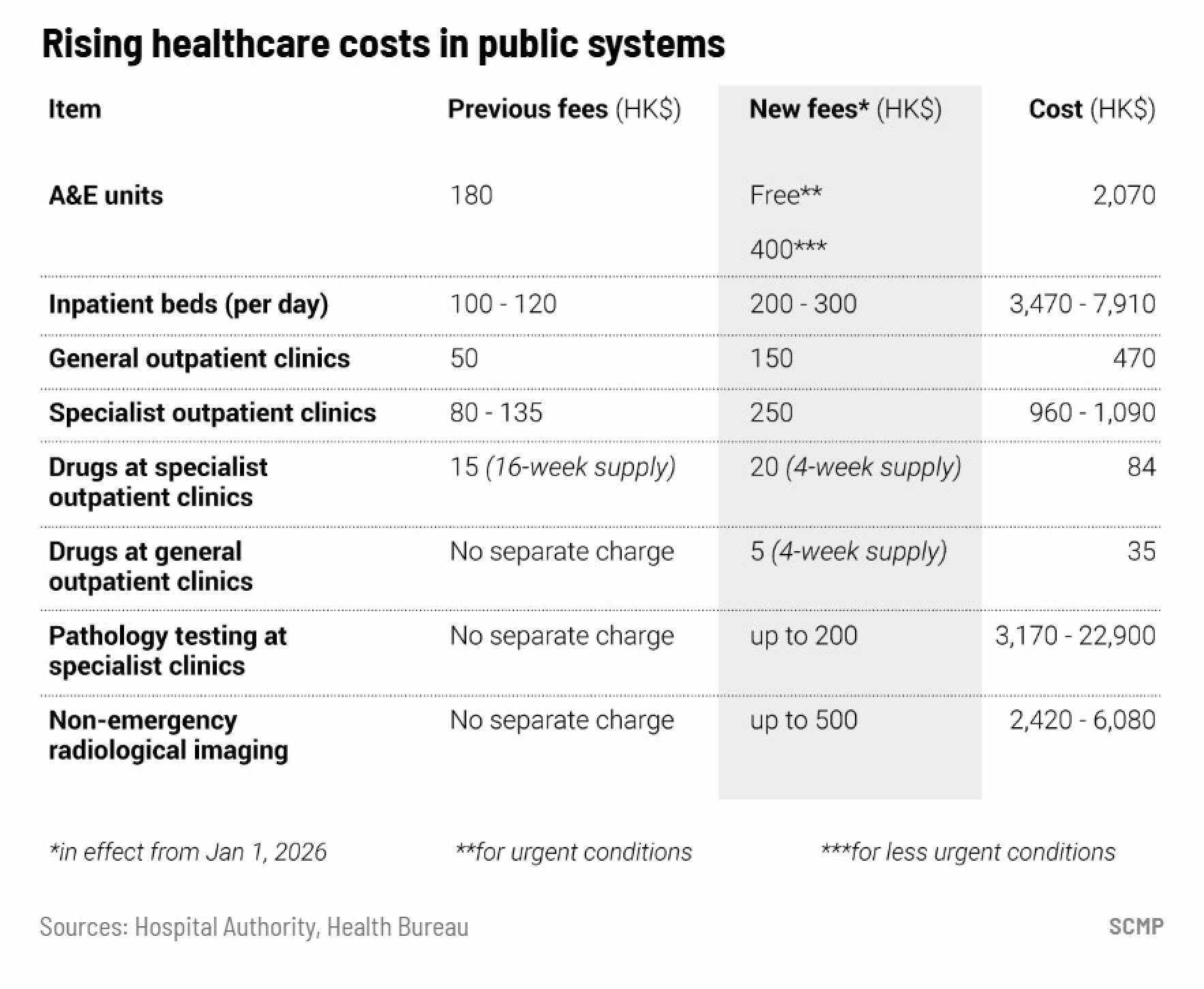
Question prompts
1. Using the chart, note TWO changes the government has made in regard to its public healthcare services.
2. According to the news and chart, why is the government pushing to reform the public healthcare system? What problems could this reform create?
Glossary
medical inflation: refers to the rising cost of medical goods and services, pharmaceuticals and health insurance over time
private insurance: coverage to pay for some or all of a person’s medical care, provided by an employer or bought directly from a private company
inpatient bills: the total cost of a hospital stay, including the room, nursing care, doctor fees, medication and medical tests. In Hong Kong, these costs differ depending on whether a patient is admitted to a public hospital managed by the Hospital Authority or a private hospital.
elective procedures: medical, surgical or diagnostic interventions that are planned in advance rather than performed as an emergency
Sample answers
News
1. C
2. According to Yuen, many Hong Kong patients are opting for private insurance to cope with medical inflation, meaning it can help them pay for private medical care if needed.
3. Despite the rising costs of overnight patient care, the government has said it aims to protect vulnerable groups by capping annual spending at HK$10,000 per patient and expanding the number of subsidised patients by relaxing income and asset thresholds. However, I don’t think these measures will be effective, as some of the qualifications may be too restrictive. For instance, those in income groups such as the middle class may not qualify for these subsidies, so the financial pressure from medical expenses remains. (accept all reasonable answers)
Chart
1. One change the government has made to public healthcare services is making the A&E units a two-tiered system, separating patients with urgent conditions and less urgent ones. Urgent cases are now completely free, while the cost for less urgent ones will rise from HK$180 to HK$400. Another change is that the government has added fees to services that used to be free, such as medication at general outpatient clinics and pathology testing at specialist clinics. (accept all reasonable answers)
2. Hong Kong’s healthcare system reform reflects a systemic push towards reducing waste and resource abuse while ensuring the government still covers the vast majority of the actual service delivery costs. This reform has the potential to create a few problems. First, it might increase pressure on middle-income groups who are not eligible for healthcare subsidies. Second, the reform might also increase pressure on general outpatient clinics and lead to overcrowding, as fewer people might opt for public healthcare facilities. Third, there is the potential for inflation across the overall healthcare system, as private clinics and hospitals might also increase their prices. (accept all reasonable answers)